Procurement is one of those business functions that most people assume is just about buying things. You need something, you find a supplier, you pay for it done. But anyone who has worked in operations, supply chain, or finance knows the reality is quite different.
A proper procurement process is not a formality. It is a structured system of checkpoints, each one designed to protect your organization from a specific type of risk. Skip one, and you do not just lose that protection you weaken every stage that follows.
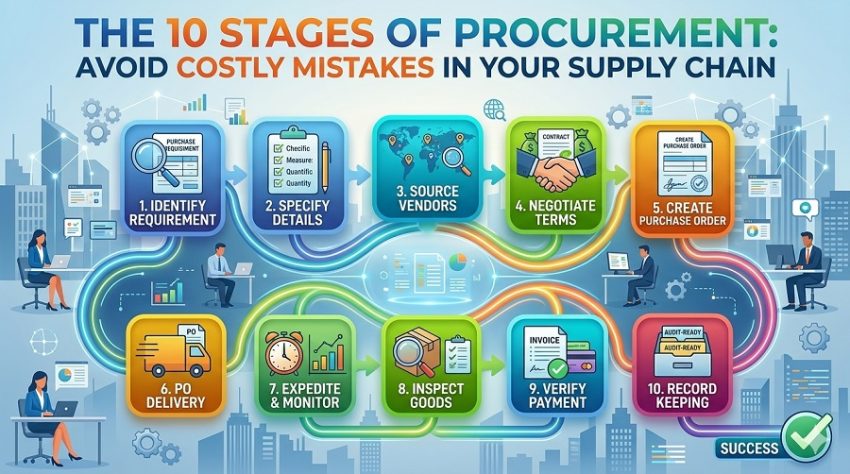
Here is a simple, honest breakdown of all 10 stages, what they do, and why they matter.
Stage 1: Identifying the Requirement
Everything starts here. Before you spend a single dollar, someone in the organization needs to clearly recognize that a need exists and articulate what that need actually is.
This sounds obvious, but it is where many procurement failures are quietly born. A vague or rushed requirement at this stage means every decision downstream is built on a shaky foundation.
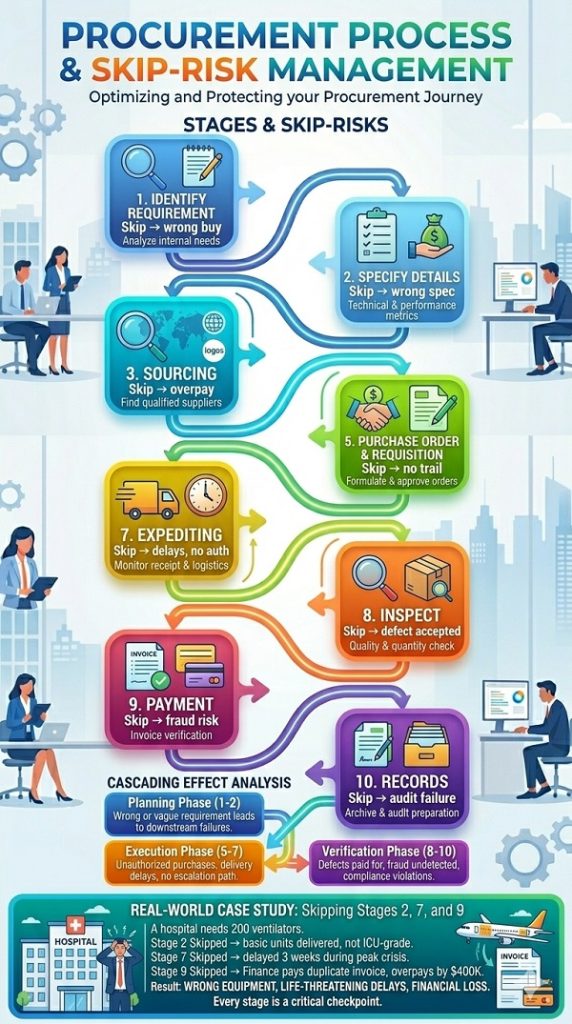
If you skip this: You end up buying something that solves the wrong problem. Time, money, and trust are lost and tracing the failure back to this moment is harder than it should be.
Stage 2: Identifying the Requirement’s Specifics
Once you know what you need, you need to define exactly what you need. This means writing out the technical specifications, quality standards, quantities, timelines, compliance requirements, and any other details that a vendor would need to deliver the right solution.
Think of this stage as drawing the target before anyone starts aiming.
If you skip this: Vendors quote based on assumptions. What arrives may technically match your vague request but fail entirely in practice. Disputes become difficult to resolve because nothing was ever formally defined.
Stage 3: Sourcing
With a clear requirement in hand, the procurement team now goes to the market. This means identifying potential vendors, issuing Requests for Proposals (RFPs), evaluating responses, and shortlisting the best candidates.
Sourcing is about creating healthy competition. When multiple qualified vendors are evaluated fairly, you get better pricing, better terms, and better accountability.
If you skip this: You default to familiar vendors without comparison. Prices stay high, innovation is missed, and over-reliance on a single supplier becomes a long-term vulnerability.
Stage 4: Price and Terms Negotiation
This is where the relationship with a selected vendor gets formalized not just on price, but on the full terms of the agreement. Payment schedules, warranties, delivery timelines, penalties for non-performance, confidentiality, and dispute resolution all live here.
Good negotiation is not about winning. It is about creating an agreement that is fair, clear, and enforceable for both sides.
If you skip this: You accept the vendor’s first offer and their standard terms. You lose money on the price, and more importantly, you lose legal protection when something goes wrong and eventually, something always does.
Stage 5: Purchase Order and Requisition
A Purchase Order (PO) is the formal, documented commitment to proceed. It references the agreed specifications, price, quantity, and delivery terms. It goes through internal approval and becomes the legal anchor for everything that follows.
This is the moment the procurement process becomes official and auditable.
If you skip this: There is no paper trail. Budget overruns happen silently. Invoices arrive without a matching authorization. And when auditors or leadership ask questions, there are no clean answers.
Stage 6: Purchase Order Delivery
The approved PO is now sent to the vendor, officially triggering their fulfillment process. This stage is about making sure the right document reaches the right people, that delivery logistics are confirmed, and that both parties are aligned on what happens next.
Simple? Yes. Skippable? Absolutely not.
If you skip this: The vendor has no formal authorization to begin. Deliveries may proceed without documentation, creating gaps that are nearly impossible to close in a dispute. Worse, delays begin here before anyone even notices.
Stage 7: Expediting
Expediting is the active monitoring of whether the vendor is on track to deliver on time. It means checking in, escalating early when issues arise, and making sure a late delivery does not become a crisis.
This stage is often the first to be quietly dropped when teams are busy and it is almost always the one people wish they had kept.
If you skip this: Problems stay hidden until it is too late. A vendor running two weeks behind schedule continues running behind, and you only find out on the delivery date. At that point, your options are limited and expensive.
Stage 8: Inspection and Supply
When goods or services arrive, they need to be checked against the original specifications before formal acceptance. This is quality control at the procurement level confirming that what was promised is what was delivered.
This is not about being difficult. It is about making sure you only pay for what you actually received.
If you skip this: Defective goods get accepted. Partial deliveries get signed off as complete. And once acceptance is confirmed, your ability to dispute or return becomes significantly weaker often disappearing entirely.
Stage 9: The Payment Procedure
Payment is released only after a successful three-way match: the Purchase Order, the delivery confirmation, and the vendor’s invoice must all align before any funds move. This process exists specifically to prevent unauthorized payments, duplicate invoices, and fraud.
It is the last financial checkpoint before money leaves the organization.
If you skip this: Invoices get paid without verification. Vendors may be paid twice. Fraudulent invoices can slip through. In organizations without a formal payment procedure, financial losses are often discovered months or even years later — and recovering them is rarely straightforward.
Stage 10: Maintaining and Examining Records
Every document from the entire procurement cycle the specifications, the PO, the contract, the inspection report, the invoice, all correspondence needs to be properly archived and retained. This is not just good practice. In most industries, it is a legal requirement.
Records are what allow organizations to learn, to audit, to defend, and to improve.
If you skip this: When disputes arise, you have nothing to refer to. When auditors ask questions, you have nothing to show. When you negotiate with the same vendor next year, you have no performance history. The entire value of the previous nine stages quietly disappears.
The Hard Truth About Skipping Stages
Here is a real example that brings all of this together.
A hospital urgently needed 200 ventilators. Under pressure, the procurement team skipped three stages. They skipped Stage 2, so no specifications were written. The vendor delivered basic units, not the ICU-grade models the clinical team actually needed. They skipped Stage 7, so nobody followed up on the delivery timeline. The equipment arrived three weeks late during the peak of the crisis it was meant to address. And they skipped Stage 9, so payment controls were bypassed. A duplicate invoice went through, and the hospital overpaid by $400,000.
Three skipped steps. Wrong equipment. Life-threatening delays. Nearly half a million dollars lost.
This is not an unusual story. Versions of it happen in manufacturing, construction, technology, and healthcare every day. The scale changes. The stages that get skipped change. But the pattern is the same: urgency creates shortcuts, shortcuts create gaps, and gaps create consequences that far outweigh the time that was supposedly saved.
Why This Matters for Your Organization
A well-run procurement process does four things that no shortcut can replicate.
It protects your budget by ensuring competition, negotiation, and payment controls are in place. It protects your operations by making sure what you receive is what you ordered, and that it arrives when you need it. It protects your legal standing by creating a documented, auditable trail from need to payment. And it protects your relationships with vendors, with auditors, and with the internal stakeholders who depend on procurement to deliver.
None of the ten stages are complicated on their own. Most take far less time than people assume. The difficulty is not in any single stage, it is in maintaining the discipline to run all ten, every time, even when the pressure to move fast feels overwhelming.
Because the cost of skipping a stage is almost never felt immediately. It accumulates quietly. And by the time it surfaces, it is always more expensive than the stage would have been.
Procurement done right is not slow. It is safe. And in business, safe is how you stay fast for the long term.
That’s all from me. I hope you find this valuable and insightful!
“Transforming Supply Chains, Empowering People, Delivering Results – Eddy Suryadi”
*Feel free to share this article with your network to help them gain valuable insights as well. For more tips and updates on supply chain management, don’t forget to connect with me on Linkedin