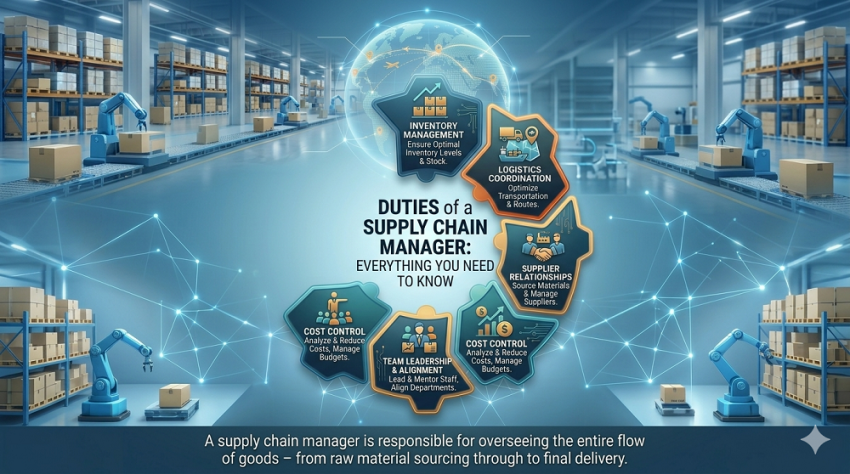
A supply chain manager is responsible for overseeing the entire flow of goods, from raw material sourcing through to final delivery. Their core duties include inventory management, logistics coordination, supplier relationships, cost control, and team leadership. In short, they keep the global supply network running smoothly every single day.
According to a 2023 McKinsey Global Institute report, companies with optimized supply chains achieve 15% lower costs and 50% fewer inventory shortages than industry peers. That’s not an accident, it’s the direct result of skilled supply chain managers executing their duties with precision. Whether you’re a business owner, a logistics professional, or someone exploring this career, understanding these duties can be the difference between a supply chain that thrives and one that collapses under pressure.
What Are the Main Duties of a Supply Chain Manager?
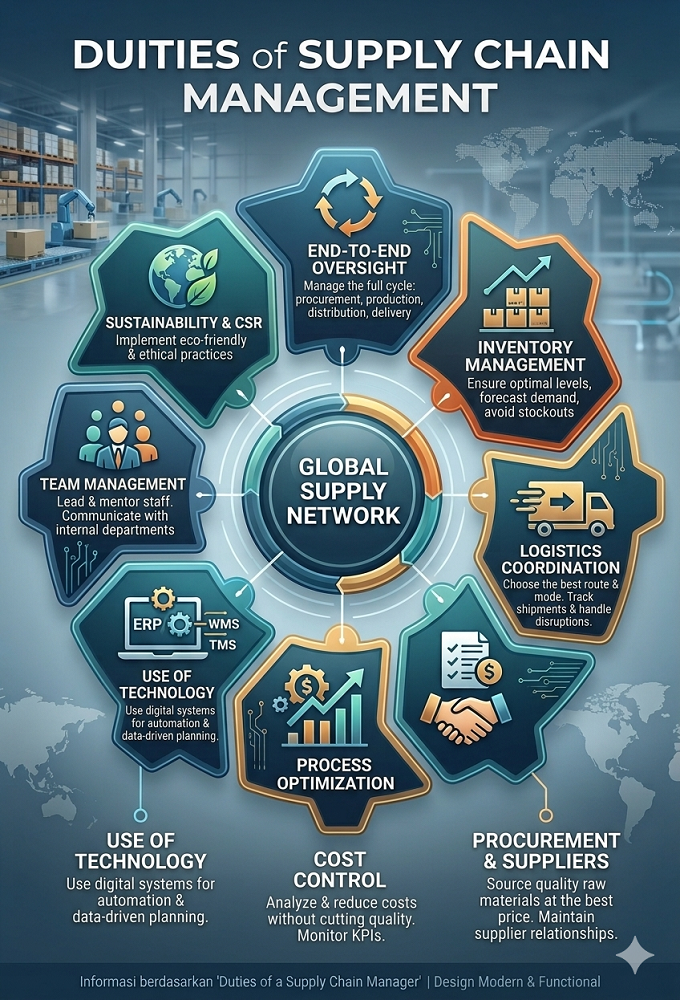
The infographic above captures it perfectly: a supply chain manager sits at the center of a Global Supply Network, balancing nine interconnected responsibilities. Let’s break each one down in plain language.
1. End-to-End Oversight
Manage the full cycle: procurement, production, distribution, and delivery.
2. Inventory Management
Maintain optimal stock levels, forecast demand, and prevent costly stockouts.
3. Logistics Coordination
Choose the best shipping routes, track shipments, and handle disruptions.
4. Procurement & Suppliers
Source quality raw materials at the best price and nurture supplier relationships.
5. Process Optimization
Continuously improve workflows to increase speed, reduce waste, and boost output.
6. Cost Control
Analyze and reduce costs without compromising quality. Monitor KPIs regularly.
7. Use of Technology
Deploy ERP, WMS, and TMS systems for automation and data-driven decisions.
8. Team Management
Lead and mentor staff. Bridge communication across internal departments.
9. Sustainability & CSR
Implement eco-friendly practices and uphold ethical sourcing standards.
How Does End to End Oversight Work in Practice?
Think of a supply chain manager as the conductor of an orchestra. Every instrument (procurement team, warehouse, logistics partner, distribution hub) has a role, but without a conductor guiding the tempo, the music falls apart.
End-to-end oversight means the manager never just looks at one stage in isolation. They track the journey of a product from the moment raw materials are ordered all the way until the customer receives their delivery.
Real-World Example
Nike’s supply chain team oversees over 500 factories across 40+ countries. Their managers don’t just watch the factory floor, they monitor fabric sourcing in Vietnam, logistics hubs in the Netherlands, and retail delivery timelines in the US, all at once. That’s true end-to-end oversight.
Why Is Inventory Management One of the Most Critical Duties?
Too much inventory means wasted capital sitting in a warehouse. Too little means stockouts, missed sales, and unhappy customers. A supply chain manager’s job is to find and maintain the perfect balance.
Key inventory management tasks include:
- Running demand forecasting using historical data and seasonal trends
- Setting reorder points so stock never hits zero unexpectedly
- Managing safety stock levels to buffer against supply delays
- Conducting regular cycle counts and reconciling discrepancies
Real-World Example
During the 2021 global chip shortage, companies like Toyota, known for their lean “just-in-time” inventory model, were forced to pause production lines. Supply chain managers who had maintained slightly higher safety stock buffers (like Samsung’s) kept production running. The lesson: inventory strategy is not just operational, it’s strategic.
What Does Logistics Coordination Actually Involve?
Logistics is more than just “shipping stuff.” A supply chain manager overseeing logistics is responsible for:
- Selecting the right mode of transport, sea freight for volume, air freight for urgency, road for last-mile flexibility
- Negotiating carrier contracts to lock in competitive rates
- Tracking shipments in real-time using TMS (Transportation Management Systems)
- Handling disruptions, port strikes, customs delays, weather events — swiftly and calmly
| Transport Mode | Best For | Trade-off |
|---|---|---|
| Sea Freight | High-volume, non-urgent goods | Slow (2–6 weeks) |
| Air Freight | Urgent, high-value shipments | Expensive (4–5x sea cost) |
| Road Freight | Regional, last-mile delivery | Limited to land routes |
| Rail Freight | Cross-continental bulk goods | Less flexible routing |
How Do Supply Chain Managers Handle Procurement and Supplier Relationships?
Procurement is about more than just finding the cheapest price. It’s about finding the right supplier at the right price with the right quality and then building a relationship that holds up when things get difficult.
Core procurement duties include:
- Issuing RFQs (Requests for Quotation) and evaluating bids fairly
- Running supplier audits to verify quality and compliance
- Negotiating payment terms that protect cash flow (e.g. Net-60 vs. Net-30)
- Diversifying the supplier base to avoid single-source risk
- Building long-term partnerships, not just transactional vendor relationships
Real-World Example
Apple maintains a dual-sourcing strategy for critical components, for example, using both TSMC and Samsung for chip production. This is a deliberate procurement decision that protects Apple’s supply chain from single-point failures. It’s the kind of strategic thinking that separates great supply chain managers from average ones.
What Role Does Technology Play in Modern Supply Chain Management?
As shown in the infographic, modern supply chain managers work with three key technology systems: ERP (Enterprise Resource Planning), WMS (Warehouse Management Systems), and TMS (Transportation Management Systems). These aren’t just software tools, they are the digital backbone of the entire operation.
| System | What It Does | Example Tools |
|---|---|---|
| ERP | Integrates finance, HR, procurement, and operations into one platform | SAP, Oracle, Microsoft Dynamics |
| WMS | Manages warehouse operations, picking, packing, and stock location | Manhattan Associates, HighJump |
| TMS | Plans, executes, and tracks shipments across carriers and modes | Blue Yonder, MercuryGate |
Beyond these core systems, leading supply chain managers are now embracing AI-driven demand forecasting, IoT-based real-time tracking, and blockchain for supplier transparency.
How Does a Supply Chain Manager Control Costs Without Cutting Corners?
Cost control is one of the most visible KPIs for a supply chain manager, and one of the most misunderstood. The goal is never just to cut costs. It’s to deliver more value for every dollar spent.
Proven cost control strategies:
- Consolidating shipments to reduce per-unit freight cost
- Negotiating volume discounts with suppliers and carriers
- Identifying and eliminating “waste” in processes (lean methodology)
- Monitoring KPIs like cost-per-order, inventory turnover, and on-time delivery rate
- Using total cost of ownership (TCO) instead of purchase price alone when evaluating suppliers
What Is the Supply Chain Manager’s Role in Sustainability and CSR?
This is increasingly non-negotiable. Consumers, regulators, and investors are all demanding more ethical and sustainable supply chains. A supply chain manager today needs to go beyond logistics, they need to think about environmental impact and social responsibility.
- Reducing carbon emissions by optimizing transport routes
- Sourcing materials from certified, ethical suppliers
- Minimizing packaging waste and adopting recyclable materials
- Conducting supplier social audits to prevent labor rights violations
- Setting and reporting against Scope 3 emission targets
Real-World Example
IKEA has committed to sourcing 100% of its wood from sustainable forests and 100% renewable energy across its supply chain by 2030. Their supply chain managers are central to executing this, tracking certifications, auditing forests, and redesigning packaging to reduce material use by over 30%.
Common Questions About Supply Chain Manager Duties
What is the most important duty of a supply chain manager?
End-to-end oversight is arguably the most critical, it ensures all other functions (inventory, logistics, procurement, cost) are coordinated and aligned toward one goal: getting the right product to the right place at the right time.
What skills does a supply chain manager need?
Analytical thinking, negotiation, proficiency with ERP/WMS/TMS systems, leadership, risk management, and a solid understanding of global trade regulations and logistics networks.
What is the difference between a supply chain manager and a logistics manager?
A logistics manager focuses specifically on transportation and warehousing. A supply chain manager has a broader scope, covering procurement, production coordination, technology, sustainability, and full end-to-end oversight of the supply network.
Why These Duties Matter More Than Ever
The COVID-19 pandemic, the Suez Canal blockage, and the global semiconductor shortage of 2021 exposed just how fragile supply chains can be — and how essential skilled supply chain managers are to business resilience. A 2024 Gartner Supply Chain Top 25 study found that companies with mature supply chain practices recover from major disruptions 2.5x faster than those without, directly linking supply chain management capability to financial performance and business survival.
From end-to-end oversight and inventory precision to sustainability commitments and technology adoption, the duties of a supply chain manager are wide-ranging, but all point toward one outcome: a resilient, efficient, and ethical global supply network that delivers real value to businesses and customers alike.
References & Research Sources:
McKinsey Global Institute (2023) – Supply Chain Performance and Cost Efficiency Benchmarks
Gartner Supply Chain Top 25 (2024) – Supply Chain Resilience and Recovery Metrics
Harvard Business Review (2022) – The Strategic Value of Supply Chain Diversification
World Economic Forum (2023) – The Future of Supply Chains: Sustainability and Technology
#supplychainduties #supplychainmanagerresponsibilities #inventorymanagement #logisticscoordination #procurementstrategy #ERP #WMS #TMS #supplychainsustainability
That’s all from me. I hope you find this valuable and insightful!
“Simplifying Supply Chains, Empowering Teams, Driving Success – Eddy Suryadi”
*Feel free to share this article with your network to help them gain valuable insights as well. For more tips and updates on supply chain management, don’t forget to connect with me on LinkedIn. Please note that all articles on this blog are available for use—personal or commercial—but must include proper credit to the author.