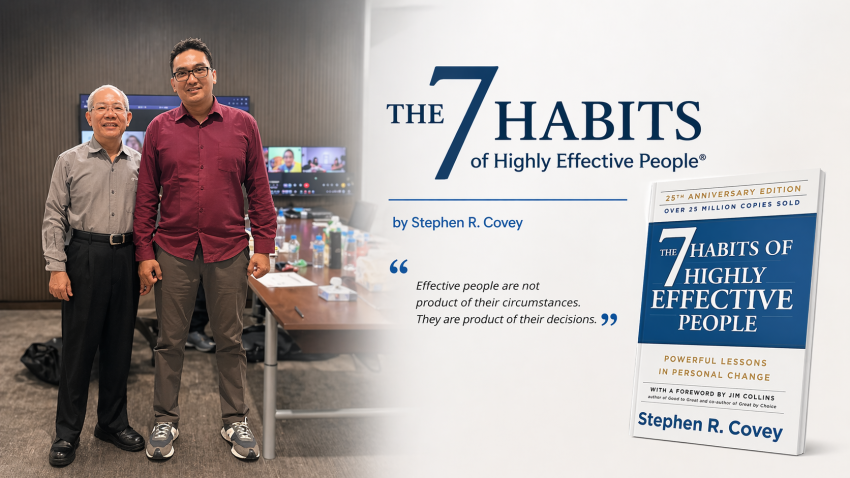
The 7 Habits of Highly Effective People is a personal leadership framework developed by Stephen R. Covey. It teaches seven core habits that shift how you see yourself, your work, and your relationships, starting from the inside out. The training is widely used in organizations to build proactive, accountable, and collaborative teams.
What Is the 7 Habits Training, And Why Does It Matter?
I’ll be honest. When I first heard we were attending a training called The 7 Habits of Highly Effective People, I thought it would be another generic workshop filled with motivational posters and things I already knew.
It was not that.
Three days into the session, I found myself rethinking how I respond to pressure, how I prioritize my day, and how I show up for my team. It was the kind of training that doesn’t just give you a new to-do list, it shifts the way you think.
Developed by Stephen R. Covey in 1989, the framework has been adopted by organizations worldwide, from Fortune 500 companies to government agencies, nonprofits, and schools. But the reason it has stood the test of time isn’t because of clever marketing. It’s because the principles are rooted in something real: character, integrity, and taking responsibility for your own life.
What Is the Difference Between Being Proactive and Reactive?
This was the concept that hit me hardest, and it came early in the training.
Habit 1 : Be Proactive
Sounds simple on paper. But the more we explored it, the more I realized how often I had been living reactively without even noticing it.
The Reactive Mindset
Reactive people let their environment control them. If the supplier is late, frustration is automatic. If a colleague says something critical in a meeting, the mood tanks for the rest of the day. If there’s chaos in the supply chain, the instinct is to blame external factors, the market, the vendor, the system.
And here is the uncomfortable truth: most of us do this every single day.
The Proactive Mindset
Proactive people don’t ignore reality. They face the same delays, the same difficult conversations, the same broken systems. But they ask a different question: “What can I control here?”
“Between stimulus and response, there is a space. In that space lies our freedom and power to choose our response.” — Stephen R. Covey
That pause, that space is everything. It means you get to decide how you show up, regardless of what’s happening around you.
A Real-World Example from Supply Chain
Imagine a shipment gets delayed, again. A reactive response might sound like: “This always happens. The vendor is useless. There is nothing we can do.”
A proactive response sounds more like: “OK. What do we know? What are the alternatives? Who do we need to contact right now?”
Same situation. Completely different outcome. That’s the shift Habit 1 is asking us to make.
Reactive vs. Proactive: A Quick Comparison
| Reactive Behavior | Proactive Behavior |
| Blames others or circumstances | Takes ownership of choices |
| Waits to be told what to do | Takes initiative before being asked |
| Uses language like ‘I can’t’ or ‘I have to’ | Uses language like ‘I choose’ or ‘I will’ |
| Mood depends on external conditions | Mood comes from inner values and decisions |
| Focuses on things outside their control | Focuses on Circle of Influence |
What Are the 7 Habits of Highly Effective People?
Here is a straightforward breakdown of all seven habits, and how each one builds on the previous:
- Be Proactive : Take responsibility for your own choices and actions. Stop waiting for conditions to be perfect.
- Begin With the End in Mind : Define what success looks like before you start. Covey calls this a “personal mission statement.”
- Put First Things First : Manage your time based on what truly matters, not just what feels urgent.
- Think Win-Win : Look for solutions that work for everyone, not just yourself.
- Seek First to Understand, Then to Be Understood : Listen to truly hear, not just to reply.
- Synergize : Combine different strengths so the whole team achieves more than the sum of its parts.
- Sharpen the Saw : Regularly renew yourself physically, mentally, emotionally, and spiritually.
Covey groups the first three habits under “Private Victory” the work you do on yourself before you can lead others. Habits 4 through 6 are about “Public Victory” how you build trust and effectiveness with the people around you. Habit 7 ties everything together by making sure you keep growing.
Why These Habits Matter in a Supply Chain Environment
Supply chain is one of those functions where reactive behavior is almost built into the culture. Fires happen every day. Pressure is constant. And it is very easy to slip into a mode where you are always responding to problems, to stakeholders, to deadlines, but never really leading.
That’s what made this training feel so relevant for our team specifically.
Habit 1 in Supply Chain Operations
When a logistics disruption happens, the proactive team member doesn’t just escalate. They bring a solution alongside the problem. They’ve already thought two steps ahead.
Habit 5 in Supplier and Stakeholder Communication
How many times have we sat in a meeting where everyone is talking but nobody is truly listening? Habit 5, seeking first to understand can transform a tense supplier negotiation into a productive conversation. You start by understanding their constraints before pushing your own.
Habit 6 in Cross-Functional Teams
Supply chain doesn’t operate in a silo. We depend on procurement, warehouse, finance, and operations. Synergy, Habit 6 means we stop trying to “win” internal debates and start trying to create outcomes that actually serve the business.
What Does the 7 Habits Training Actually Look Like?
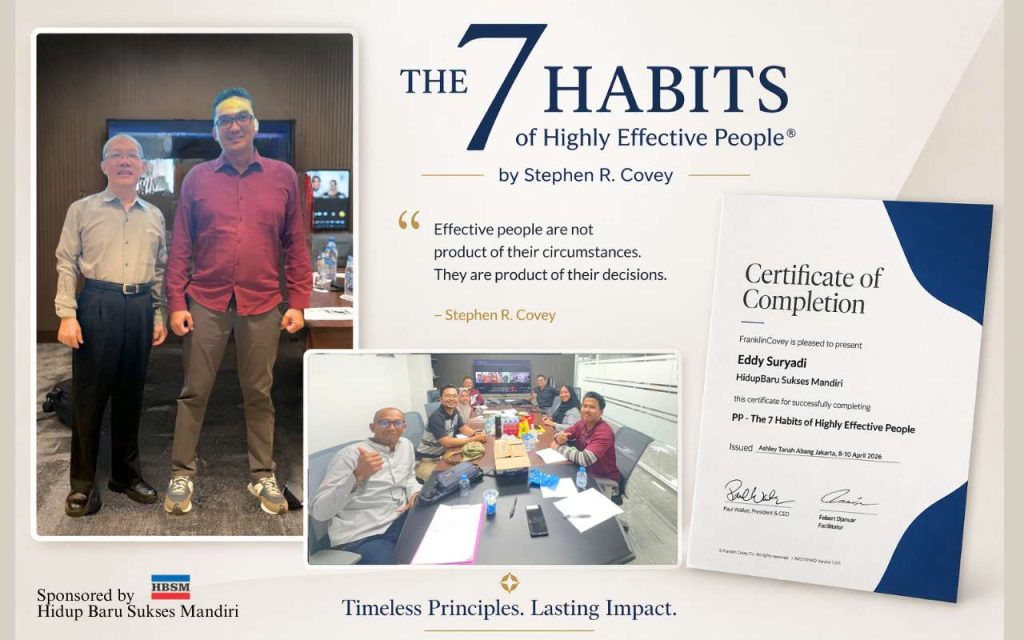
The training is typically delivered over two days, though formats vary depending on the provider. The version I attended included a mix of group discussion, self-reflection exercises, video content from FranklinCovey, and real-world case studies.
What I appreciated most was that it wasn’t lecture-heavy. There was a lot of space for conversation, people sharing how these habits connected (or clashed) with their real experience at work. Some moments got surprisingly personal, in a good way.
One exercise that stood out was the “Big Rocks” activity. You’re given a container and asked to fit in large rocks, small pebbles, and sand. The lesson: if you fill the container with small stuff first, the big rocks won’t fit. But if you put the big rocks in first, everything else finds its way in. It’s a physical metaphor for prioritization and it stuck with me in a way that no slide deck ever has.
Is the 7 Habits Training Worth It?
Based on my experience, yes. But only if you go in willing to be honest with yourself.
The 7 Habits is not a quick-fix framework. It doesn’t hand you a productivity hack or a shortcut to better performance. What it does is invite you to look at your own patterns, how you respond to stress, how you set priorities, how you build trust and ask whether those patterns are actually serving you and the people around you.
For teams that are growing, navigating change, or trying to build a stronger culture, this training provides a shared language and a common foundation. And that, in the long run, is worth more than most technical skills training.
Key Takeaways from the Training
If I had to summarize what I walked away with, it would be these:
- You can’t change everything, but you can always choose your response.
- Effectiveness starts from within, your character, your values, your self-awareness.
- Listening is a skill, and most of us are not as good at it as we think.
- Prioritization is not about time management, it’s about knowing what truly matters.
- Teams that think Win-Win, communicate openly, and leverage each other’s strengths outperform teams that rely on individual talent alone.
- Growth requires renewal. You cannot keep giving if you never invest in yourself.
Sharing These Lessons With My Team
One of the most meaningful parts of the experience was having the chance to bring these lessons back to my team in the Supply Chain department.
I didn’t do it by presenting a full slide deck of everything I learned. I started with one question in our weekly meeting: “When something goes wrong today, are we choosing our response or are we just reacting?”
That led to one of the most honest conversations our team has had in a while. People started sharing examples from their own work. They started connecting the idea of proactivity to situations they had been struggling with for months.
That’s what good learning does. It doesn’t stay in the training room. It travels.
Last but Not Least
The 7 Habits of Highly Effective People has been around for more than three decades, and it still resonates because it speaks to something timeless: the kind of person you choose to become when things get hard.
I’m still practicing. Some days I’m proactive; some days I react before I even realize I had a choice. But the difference is that now I notice it. And that’s where change begins.
If you’re looking for a training that goes beyond skills and actually challenges you to grow as a person and a professional — this is one worth experiencing.
“We are not our feelings. We are not our moods. We are not even our thoughts. We are the one who decides, in any given moment, how to respond.”
That’s all from me. I hope you find this valuable and insightful!
“Transforming Supply Chains, Empowering People, Delivering Results – Eddy Suryadi”
*Feel free to share this article with your network to help them gain valuable insights as well. For more tips and updates on supply chain management, don’t forget to connect with me on Linkedin