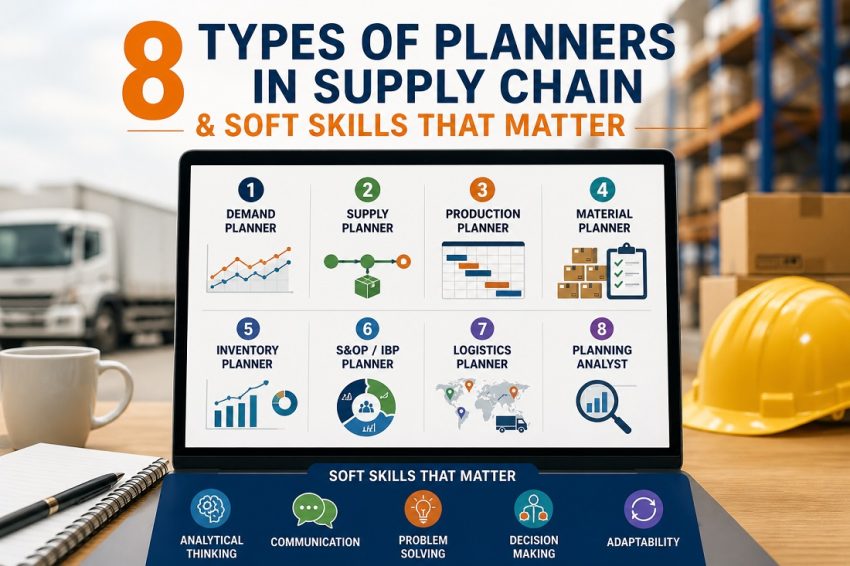
There are 8 main types of supply chain planners: Demand Planner, Supply Planner, Production Planner, Material Planner, Inventory Planner, S&OP/IBP Planner, Logistics Planner, and Planning Analyst. Each role has a different focus, but all require strong soft skills to be truly effective.
If you work in supply chain, or you are trying to build a career in it, one of the first things you realise is that not all planners do the same job. The title ‘supply chain planner’ is a broad umbrella. Under it, you will find eight very different roles, each with its own responsibilities, tools, and ways of thinking.
Research from the Association for Supply Chain Management (ASCM) consistently shows that technical knowledge alone is not what separates good planners from great ones. Soft skills, like communication, adaptability, and analytical thinking, are what allow planners to turn data into decisions that actually move supply chains forward. A 2023 Gartner report on supply chain talent gaps found that 67% of supply chain leaders rated ‘human-centric skills’ as critical for planning roles, more so than any specific software certification.
This guide breaks down all 8 types of supply chain planners, what they actually do day to day, and the soft skills you need to succeed in each one.
At a Glance: All 8 Types of Supply Chain Planners
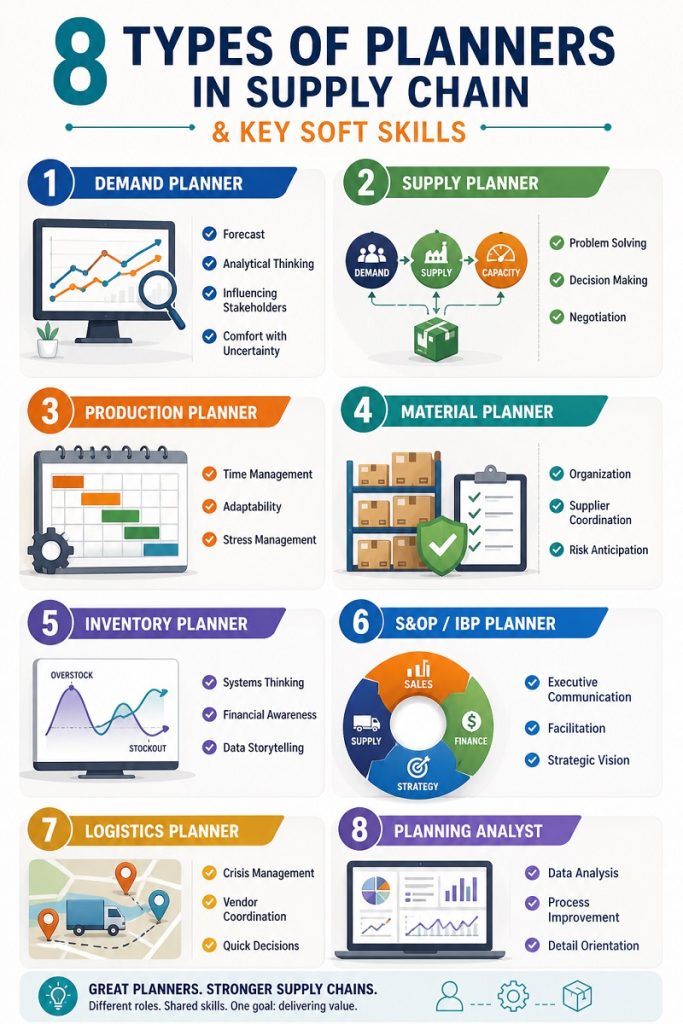
Here is a quick reference table. We will dig into each one in detail below.
| Planner Role | Core Focus | Top Soft Skills |
| Demand Planner | Forecasting future customer needs | Analytical Thinking, Comfort with Uncertainty |
| Supply Planner | Matching supply with demand & capacity | Problem Solving, Decision Making, Negotiation |
| Production Planner | Scheduling manufacturing operations | Time Management, Adaptability, Stress Management |
| Material Planner | Managing raw material procurement | Organization, Supplier Coordination, Risk Anticipation |
| Inventory Planner | Balancing stock levels | Systems Thinking, Financial Awareness, Data Storytelling |
| S&OP / IBP Planner | Aligning sales, finance & supply strategy | Executive Communication, Facilitation, Strategic Vision |
| Logistics Planner | Managing transport & delivery | Crisis Management, Vendor Coordination, Quick Decisions |
| Planning Analyst | Data analysis & process improvement | Data Analysis, Process Improvement, Detail Orientation |
1. Demand Planner — The Forecaster
What Does a Demand Planner Actually Do?
A Demand Planner’s job is to predict how much of a product customers will want, and when they will want it. They look at historical sales data, market trends, seasonal patterns, and sometimes even weather or economic signals to build a forecast. This forecast then drives almost everything else in the supply chain, from how much raw material to order to how many staff a warehouse needs on a given week.
Real-world example: At a fast-moving consumer goods (FMCG) company like Unilever, a Demand Planner might notice that demand for a specific laundry detergent consistently spikes in March across Southeast Asia. Using that data, they adjust the forecast upward and communicate early to the supply team, preventing a stockout before it happens.
Key Soft Skills for Demand Planners
- Forecast accuracy and statistical thinking
- Analytical Thinking : turning numbers into a story
- Influencing Stakeholders : convincing sales teams to trust the numbers
- Comfort with Uncertainty : forecasts are never perfect, and that is okay
2. Supply Planner — The Balancer
What Does a Supply Planner Actually Do?
Where a Demand Planner asks ‘how much will we need?’, the Supply Planner asks ‘how much can we get, and when?’ They work to align available supply with forecasted demand, keeping an eye on supplier lead times, factory capacity, and inventory buffers. It is a balancing act, and it requires constant communication with both internal teams and external partners.
Real-world example: A Supply Planner at a car manufacturer might realise a key component from a supplier in Malaysia will arrive two weeks late due to port delays. They immediately run scenario planning to decide whether to prioritise which vehicle models get the available stock, and they negotiate with the supplier on airfreighting part of the order at premium cost.
Key Soft Skills for Supply Planners
- Problem Solving : quick thinking under pressure
- Decision Making : choosing between imperfect options
- Negotiation : with suppliers, logistics partners, and internal stakeholders
3. Production Planner — The Scheduler
What Does a Production Planner Actually Do?
Production Planners live inside the factory environment. Their job is to create and manage production schedules that make sure the right products are manufactured at the right time, in the right quantities, without overloading machines or people. They act as a bridge between demand and operations.
Real-world example: A Production Planner at a food processing plant has to juggle multiple product lines on shared equipment. When a machine breaks down on a Tuesday morning, they immediately reschedule three production runs, shift labour allocation, and communicate the updated delivery timeline to logistics. Without strong stress management, this role burns people out fast.
Key Soft Skills for Production Planners
- Time Management : everything in manufacturing runs on tight timelines
- Adaptability : plans change, often hourly
- Stress Management : disruptions are a daily reality, not an exception
4. Material Planner — The Procurer
What Does a Material Planner Actually Do?
Material Planners make sure that the right raw materials and components are in the right place at the right time. They work closely with procurement and suppliers to ensure nothing runs out, while also making sure the company is not holding too much stock and tying up capital. In manufacturing industries, this role is often called MRP (Material Requirements Planning) Planner.
Real-world example: An electronics manufacturer’s Material Planner tracking the supply of microchips during a global semiconductor shortage has to actively manage risk. They pre-order buffer stock, qualify alternative suppliers, and build a risk log of components that are in short supply. The ‘Risk Anticipation’ skill is not optional here, it is survival.
Key Soft Skills for Material Planners
- Organization : managing dozens of SKUs and supplier relationships simultaneously
- Supplier Coordination : clear, consistent communication with vendors
- Risk Anticipation : thinking ahead to spot what could go wrong
5. Inventory Planner — The Stock Strategist
What Does an Inventory Planner Actually Do?
Inventory Planners focus on optimising stock levels across the supply chain network. Too much inventory ties up cash and fills warehouses. Too little inventory causes stockouts and unhappy customers. The Inventory Planner’s job is to find that sweet spot and maintain it, using data, replenishment models, and a deep understanding of the business.
Real-world example: A retail inventory planner working for an e-commerce brand in Indonesia notices a pattern where certain SKUs go into overstock in Q3 every year due to inaccurate promotions forecasting. They design a revised replenishment policy with higher safety stock thresholds only for high-velocity items. Then they present the data to leadership as a business case. That is data storytelling in action.
Key Soft Skills for Inventory Planners
- Systems Thinking : seeing how stock levels affect the whole supply chain
- Financial Awareness : understanding the cost of holding versus the cost of shortage
- Data Storytelling : turning spreadsheet data into clear, compelling insights
6. S&OP / IBP Planner — The Strategic Integrator
What Does an S&OP or IBP Planner Actually Do?
S&OP stands for Sales and Operations Planning. IBP stands for Integrated Business Planning, which is the more advanced version. This role sits at the intersection of sales, finance, supply chain, and executive leadership. The S&OP Planner facilitates the monthly planning cycle where all departments align on one unified plan for the business. It is one of the highest-impact planning roles in any organisation.
Real-world example: At a pharmaceutical company, the S&OP Planner runs a monthly meeting attended by the CFO, Head of Sales, and Supply Chain Director. They present a single integrated view of demand versus supply versus financial targets. When the numbers do not add up, they facilitate the conversation to close the gap. Poor executive communication skills? You will not last long in this role.
Key Soft Skills for S&OP / IBP Planners
- Executive Communication : presenting to and influencing senior leadership
- Facilitation : running productive cross-functional meetings
- Strategic Vision : thinking in quarters and years, not just days and weeks
7. Logistics Planner — The Movement Manager
What Does a Logistics Planner Actually Do?
Logistics Planners manage the physical movement of goods. They coordinate transport modes (road, sea, air, rail), plan delivery routes, manage carrier relationships, and make sure products get from point A to point B on time and within budget. This role is highly operational and often requires fast decision-making under pressure.
Real-world example: A Logistics Planner at a consumer electronics distributor gets a call on Friday afternoon: the vessel carrying 10,000 units from China has been rerouted due to bad weather and will arrive four days late. They immediately start calling alternative carriers, renegotiating delivery windows with customers, and flagging the financial impact to management. Vendor coordination and crisis management are not optional extras here.
Key Soft Skills for Logistics Planners
- Crisis Management : staying calm and finding solutions when things go wrong
- Vendor Coordination : managing multiple carriers and third-party logistics providers
- Quick Decisions : speed matters when shipments are at stake
8. Planning Analyst — The Data Architect
What Does a Planning Analyst Actually Do?
Planning Analysts are the data backbone of the supply chain planning function. They build reports, design dashboards, run scenario analyses, and help other planners make better decisions through better data. In companies using advanced tools like SAP IBP, Oracle, or Power BI, the Planning Analyst is often the person who actually builds and maintains the models.
Real-world example: A Planning Analyst at a retail chain notices that the current replenishment report has been giving planners incorrect lead times because of a data feed error. They trace the problem back to a system integration issue, fix it, and then redesign the report to flag anomalies automatically in the future. Detail orientation is what made them notice it in the first place.
Key Soft Skills for Planning Analysts
- Data Analysis : going beyond the numbers to find the story
- Process Improvement : always asking ‘how could this work better?’
- Detail Orientation : catching errors that others miss
Why Do Soft Skills Matter So Much in Supply Chain Planning?
This is a fair question. Supply chain is often thought of as a numbers-and-systems job. And yes, you need to know your way around Excel, ERP systems, and statistical forecasting tools. But the planners who genuinely move the needle are almost always the ones who can also do the following:
- Communicate complex trade-offs in plain language that leadership can act on
- Build trusted relationships with suppliers, commercial teams, and operations
- Stay calm and structured when the plan falls apart, which it will
- Influence decisions even when they do not have formal authority
A study published in the International Journal of Physical Distribution and Logistics Management found that interpersonal and communication skills were among the top predictors of supply chain professional performance, above both technical knowledge and years of experience. The research specifically highlighted that planners who could ‘translate data into actionable business language’ consistently delivered better outcomes than those who could not.
Which Type of Planner Should You Aim to Be?
If you are early in your career, starting as a Demand Planner or Planning Analyst gives you the broadest exposure to data, systems, and cross-functional collaboration. From there, the paths are many:
- Strong with numbers and systems? Go deep into Inventory Planning or IBP.
- Love working with factories and operations? Production or Material Planning is your home.
- Good at building relationships and presenting? S&OP or Logistics Planning suits you well.
- Passionate about data and technology? Planning Analyst is a fast-growing and highly valued path.
Most experienced supply chain professionals move across several of these roles throughout their careers. And every move teaches you something new about how the supply chain fits together.
Last From Me
Great supply chains are built by great planners. And great planners are not just technically competent. They are adaptable, communicative, analytical, and calm under pressure. The eight roles covered in this article each play a unique part in keeping products moving from source to shelf.
Whether you are a hiring manager building a planning team, a supply chain professional thinking about your next career move, or a student just starting to explore the field, understanding these roles deeply, and the soft skills behind them, gives you a real edge.
As the World Economic Forum’s Future of Jobs Report (2023) noted, ‘complex problem-solving, critical thinking, and people management’ are the top three skills that supply chain professionals will need through 2027 and beyond. Technical tools will change. Soft skills are the constant.
Great planners make stronger supply chains. And stronger supply chains deliver real value to people, businesses, and economies around the world.
References
1. ASCM (Association for Supply Chain Management) — Supply Chain Talent Benchmarking Report, 2023
2. Gartner — Supply Chain Talent Gap and Human-Centric Skills Report, 2023
3. International Journal of Physical Distribution and Logistics Management — ‘Interpersonal Skills in Supply Chain Performance’, 2021
4. World Economic Forum — The Future of Jobs Report, 2023
That’s all from me. I hope you find this valuable and insightful!
“Transforming Supply Chains, Empowering People, Delivering Results – Eddy Suryadi”
*Feel free to share this article with your network to help them gain valuable insights as well. For more tips and updates on supply chain management, don’t forget to connect with me on Linkedin