If you’re just starting out in supply chain or inventory planning, first of all, welcome. It can feel like a lot to take in at first. There are spreadsheets, systems, numbers, and jargon flying around everywhere.
But here’s the honest truth: most of the job comes down to a handful of core ideas. Once you get comfortable with these, everything else starts to make sense.
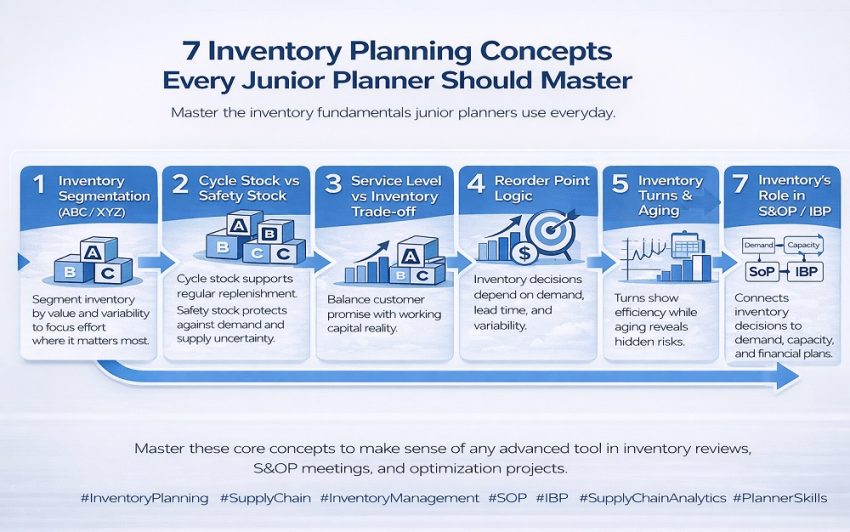
This article walks you through seven concepts that will genuinely help you do your job better and feel more confident while doing it.
1. Inventory Segmentation (ABC/XYZ Analysis)
Not all items deserve the same amount of your attention. That’s the whole point of segmentation.
ABC Analysis is about value:
- A items are your most important, high-value products.
- B items are somewhere in the middle.
- C items are low-value and don’t need much watching.
XYZ Analysis is about how predictable demand is:
- X items sell in a steady, consistent pattern.
- Y items fluctuate a bit.
- Z items are all over the place, hard to predict.
When you combine both, you get a clearer picture. An “AX” item is high-value and predictable that needs close attention. A “CZ” item? You can afford to be more relaxed about it.
This simple idea saves you a lot of wasted energy.
2. Cycle Stock vs. Safety Stock
These two types of stock serve different purposes, and mixing them up can cause real problems.
Cycle stock is what you use day-to-day to keep operations running. It’s your regular working inventory.
Safety stock is your backup, a buffer you keep just in case something goes wrong, like a supplier running late or demand suddenly spiking.
Too little safety stock and you run out of things you need. Too much and you’re tying up money that could be used elsewhere.
Finding that balance is one of the most practical skills you’ll build as a planner. It takes time, but it’s worth getting right.
3. Service Level vs. Inventory Trade-Off
Here’s a tension that every planner deals with: the better the service you want to provide, the more inventory you usually need to hold and that costs money.
High stock levels mean fewer stockouts and happier customers. But they also mean higher storage costs and tied-up cash.
Lower stock levels save money but increase the risk of running short.
There’s no perfect answer. The right balance depends on your business, your customers, and what matters most to your leadership. Your job is to understand the trade-off clearly so you can have honest conversations about it.
4. Reorder Point Logic
A reorder point simply answers the question: when should we order more?
To figure that out, you need to consider three things:
- How much you typically sell or use (average demand)
- How long it takes to get stock in (lead time)
- How much that demand and lead time can vary
Get this right, and your stock arrives just when you need it, not too early, not too late. Get it wrong, and you’re either sitting on too much inventory or scrambling to cover a gap.
It’s one of those things that sounds simple but takes a bit of practice to apply well in the real world.
5. Inventory Turns and Aging
These two metrics help you understand how healthy your inventory really is.
Inventory turns tell you how often your stock is being used or sold in a given period. Higher turns generally mean you’re running lean and efficiently. Lower turns can be a sign that something’s sitting around longer than it should.
Inventory aging shows you how long specific items have been in storage. If something has been sitting there for months, it’s worth asking why and whether it’s still needed.
Keeping an eye on both helps you spot problems early before they become expensive.
6. Demand, Lead Time, and Variability
This one is a bit more of a mindset than a single tool.
Good planners are always asking:
- What’s our demand going to look like?
- How long does it take to get stock in?
- How much could either of those things change?
You won’t always have perfect data. But developing a habit of thinking about uncertainty and building it into your planning makes a big difference. It’s what separates a reactive planner from a proactive one.
7. Inventory’s Role in S&OP and IBP
Inventory doesn’t exist in a bubble. It connects to everything : sales, finance, operations, procurement, logistics.
S&OP (Sales and Operations Planning) is a regular process where different parts of the business come together to align on demand and supply.
IBP (Integrated Business Planning) takes that further by bringing in financial planning too.
As a junior planner, you might not be leading these conversations yet. But understanding how your work feeds into the bigger picture is really valuable. It helps you see why decisions are made the way they are — and it prepares you for more responsibility down the road.
Why Does All This Matter?
These seven concepts aren’t just theory. They directly affect:
- Whether operations run smoothly or grind to a halt
- How much working capital the business ties up in stock
- Whether customers get what they need, when they need it
- How well you can explain your decisions to others
More than anything, getting comfortable with these ideas will make you feel less lost and more useful in your day-to-day role.
Closing Thoughts
You don’t need to master everything at once. Start with the basics, ask questions, and pay attention to what’s happening around you. Every situation you encounter is a chance to learn something.
Inventory planning is a skill that builds gradually. The planners who do it well aren’t necessarily the smartest people in the room, they’re the ones who stayed curious, kept things simple, and didn’t stop learning.
You’re already on the right track by starting here.
That’s all from me. I hope you find this valuable and insightful!
“Transforming Supply Chains, Empowering People, Delivering Results – Eddy Suryadi”
*Feel free to share this article with your network to help them gain valuable insights as well. For more tips and updates on supply chain management, don’t forget to connect with me on Linkedin