A supply planner controls inventory policies, order quantities, safety stock levels, replenishment timing, and supplier communication. They cannot control sudden demand spikes, raw material shortages, supplier delays, port disruptions, or macroeconomic shifts. Understanding this boundary is what separates reactive firefighting from strategic supply planning.
What Does a Supply Planner Actually Do?
If you work in supply chain, you know this feeling. A customer escalates because a product is out of stock. Your manager asks why. And somehow the supply planner ends up in the middle of the conversation, trying to explain why a typhoon in Southeast Asia is their fault.
The truth is, supply planning is one of the most misunderstood roles in any business. People assume that if inventory goes wrong, the planner must have done something wrong. But that is only half the story.
A supply planner’s job is to ensure the right product is available at the right time, in the right quantity, at the right cost. They sit between demand (sales, marketing, customers) and supply (vendors, warehouses, logistics). They are the balancing act between two worlds that rarely cooperate perfectly.
There is a very real boundary between what they can influence and what simply lies outside their hands. Understanding this distinction matters for planners, their managers, and every team that depends on them.
At a Glance: Control vs. No Control
The table below gives a quick overview before we go deeper into each area.
| What a Supply Planner CAN Control | What a Supply Planner CANNOT Control |
| Safety stock levels | Sudden demand spikes from the market |
| Reorder points and order quantities | Supplier capacity or machine breakdowns |
| Inventory allocation to customers | Port congestion and freight delays |
| Supplier forecast sharing | Natural disasters and pandemics |
| Planning horizon and review cadence | Inaccurate forecasts from sales or marketing |
| Early risk escalation to the business | Budget decisions made by leadership |
| Replenishment cycle optimization | Currency and commodity price fluctuations |
| Scenario planning and contingency prep | Geopolitical events affecting trade routes |
What Can a Supply Planner Control?
This is where a skilled supply planner earns their keep. The decisions within their authority can significantly reduce risk, lower costs, and improve service levels. These are also the areas where they should be held accountable.
1. Safety Stock Levels
Safety stock is the buffer inventory a planner deliberately holds to protect against unexpected demand or supply variability. A well-calibrated planner sets this based on historical demand patterns, lead time variability, and service level targets.
For example, a planner at a consumer goods company might see from 18 months of data that a certain product averages 200 units per week but climbs to 280 units in the four weeks before a major holiday. By building in a 10-day buffer during that season, they reduce stockout risk without over-investing in warehouse space the rest of the year.
This is a decision fully within the planner’s control, and it has a direct impact on both customer service levels and working capital.
2. Reorder Points and Order Quantities
When should you reorder? How much? These are the two most fundamental supply planning decisions. Planners use tools like Economic Order Quantity models, min/max rules, or dynamic replenishment logic to answer them.
A planner who sets a reorder point too low will constantly firefight stockouts. One who sets it too high will tie up cash in excess inventory. Finding the right number requires data, judgment, and regular review. All of that belongs to the planner.
3. Supplier Communication and Forecast Sharing
While a planner cannot force a supplier to deliver on time, they can make late deliveries less likely. Sharing rolling forecasts early, confirming orders proactively, and flagging potential shortfalls weeks in advance all reduce the chances of being caught off guard.
A senior planner at a global electronics manufacturer shared that their team reduced lead time variability by around 20 percent by switching from reactive purchase orders to a 12-week rolling forecast shared with key vendors every Monday. That discipline is entirely within the planner’s hands.
4. Inventory Allocation
When supply is constrained, the planner decides who gets product first. Which customer? Which region? Which channel? Thoughtful allocation protects the highest-value relationships and the highest-margin SKUs during a shortage. Poor allocation, on the other hand, can damage customer trust and erode revenue.
5. Planning Horizon and Review Cadence
How far ahead does the planner look? Weekly? Monthly? A 13-week rolling window? The choice of planning cadence determines how early the team can detect and react to change. Planners who review replenishment weekly catch problems faster than those who review monthly. This is a process decision within their control.
6. Early Risk Escalation
One of the most underrated responsibilities in supply planning is raising risk before it becomes a crisis. A planner who spots a potential shortage 10 weeks out can work with procurement, logistics, or commercial teams to find a solution. A planner who flags it two weeks out leaves the business with almost no options.
Proactive communication is 100 percent within the planner’s control, and it is often the difference between a manageable situation and a full escalation.
What Can a Supply Planner NOT Control?
This is the honest part that job descriptions often leave out. No matter how skilled the planner, some forces simply sit outside their authority. Recognizing this is not an excuse. It is a sign of maturity in supply chain thinking, and it helps organizations build more realistic expectations.
1. Demand Volatility
The market decides what customers want and when they want it. A sales team can run a promotion without telling the supply planner. A competitor can go out of stock and redirect demand your way overnight. A viral social media post can spike orders by 400 percent in 48 hours.
A planner can build statistical models that anticipate some variability, and they can hold safety stock to absorb reasonable swings. But they cannot predict or prevent genuine demand shocks. When a major retailer unexpectedly ran a national television campaign for a kitchen appliance brand and gave the supply team 36 hours notice, the resulting stockout was not a planning failure. It was an information gap created outside the planning function entirely.
2. Supplier Reliability and Capacity
A supplier’s on-time delivery depends on their own internal operations, their raw material supply chains, their workforce, and their equipment. A planner can communicate clearly and flag urgency. They cannot walk into a supplier’s factory and fix a broken production line.
When global shipping container availability collapsed in late 2021 and 2022, planners across every industry faced lead time extensions of four to twelve weeks beyond normal. None of those delays were caused by decisions inside the company. They were systemic supply-side disruptions, and the best planners could do was limit the damage.
3. External Disruptions
Natural disasters, pandemics, port strikes, geopolitical conflicts, and trade policy changes all affect supply chains in ways no planner can control. These events are sometimes called force majeure. They are not anomalies. They are a permanent part of the supply planning landscape.
The best response is to maintain scenario plans, build alternative supplier options, and communicate impact quickly to the business. The disruption itself is beyond any planner’s reach.
4. Demand Forecasts Created Elsewhere
In most organizations, the demand forecast is owned by a demand planning team, a commercial team, or sometimes a combination of both. The supply planner receives the forecast and plans supply against it. If the forecast is consistently wrong by 30 percent, the supply plan will be wrong too, even if the planner followed every best practice available.
This is why the working relationship between demand planning and supply planning is so important. A planner inheriting a consistently inaccurate forecast is managing a structural problem that sits upstream of their role.
5. Leadership Budget Decisions
A planner may recommend building additional safety stock to cover an upcoming risk period. If leadership decides not to invest in that inventory due to cash flow constraints, the planner must work within that boundary. They can document the recommendation, quantify the risk in service level terms, and escalate through the right channels. The final decision belongs to the business, not the planner.
Read : 8 Types of Planners in Supply Chain & Soft Skills That Matter
Risk Response Framework: What Should a Planner Do?
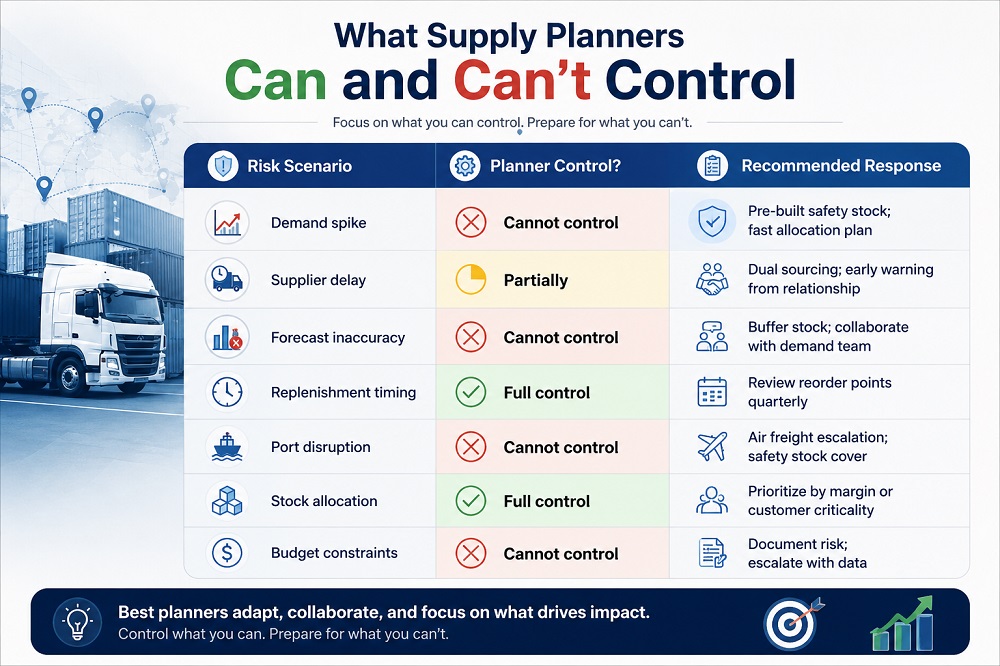
Knowing what you cannot control is useful. Knowing what to do about it is more useful. The table below maps common supply planning risks to the level of planner control and the recommended response.
| Risk Scenario | Planner Control? | Recommended Response |
| Demand spike | Cannot control | Pre-built safety stock; fast allocation plan |
| Supplier delay | Partially | Dual sourcing; early warning from relationship |
| Forecast inaccuracy | Cannot control | Buffer stock; collaborate with demand team |
| Replenishment timing | Full control | Review reorder points quarterly |
| Port disruption | Cannot control | Air freight escalation; safety stock cover |
| Stock allocation | Full control | Prioritize by margin or customer criticality |
| Budget constraints | Cannot control | Document risk; escalate with data |
Which KPIs Does a Supply Planner Actually Own?
One of the most common frustrations in supply planning is being measured on metrics that depend on other teams. Forecast accuracy, for example, is heavily influenced by the demand planning team. Supplier on-time delivery depends on procurement relationships and vendor performance.
Below is a practical breakdown of which metrics a supply planner truly owns, which ones are shared, and which ones sit outside their direct influence.
| KPI / Metric | Planner Owns? | Shared With |
| Safety stock level | Yes | No |
| Inventory turnover | Partly | Yes — with finance |
| Order fill rate | Partly | Yes — with logistics |
| Supplier on-time delivery | No | Yes — with procurement |
| Forecast accuracy | No | Yes — with demand planning |
| Days of supply | Yes | No |
| Stockout frequency | Partly | Yes — with demand and sales |
| Replenishment lead time | No | Yes — with suppliers |
This matters because holding a planner accountable for a shared or uncontrollable metric without acknowledging those dependencies is one of the fastest ways to lose good people. The most effective supply chain teams are clear about ownership and build accountability structures that reflect reality.
How Can a Supply Planner Handle What They Cannot Control?
Knowing what you cannot control is the first step to handling it well. The best supply planners do not waste energy trying to prevent the unpredictable. Instead, they build resilience so that when disruptions happen, the impact is smaller and the recovery is faster.
Build and Maintain Scenario Plans
Rather than planning for one expected future, experienced planners keep two or three scenarios ready. What happens if lead times extend by six weeks? What if demand comes in 35 percent above forecast for three months? Having these scenarios ready means you are never starting from scratch when something goes wrong.
Communicate Risk Early and Often
A planner who identifies a potential shortage 12 weeks out gives the business real options. Air freight, alternative suppliers, demand-side promotions to clear other stock, or customer communication. A planner who flags the same risk two weeks out has almost none of those levers available.
The most valuable habit a supply planner can build is regular, clear risk communication. Not every risk will materialize. But the ones that do will be managed far better when the business has been informed in advance.
Treat Supplier Relationships as Strategic
You cannot control whether your supplier has a production issue. But a strong relationship means they will call you first when they do. That early warning is genuinely valuable. Planners who treat vendors as partners rather than transactional order-takers consistently receive better information, better prioritization during tight supply, and more flexibility when they need it.
Document Decisions and Assumptions
When a stockout happens after a demand spike no one predicted, the planner needs to show their work. Good documentation of the safety stock rationale, the forecast assumptions used, and the risk flags raised protects both the planner and the business. It also feeds the post-mortem process so the organization learns and improves for next time.
- Set safety stock based on lead time variability and target service level, not gut feel
- Review reorder points at least quarterly, or after any major demand or supply shift
- Share rolling forecasts with suppliers on a regular cadence, not just at order time
- Flag supply risks in writing, even when the risk seems unlikely
- Maintain a list of alternative suppliers for your highest-risk SKUs
- Document every major planning decision with the assumptions behind it
The Bottom Line
Supply planning is not about having perfect control. It never was. The role is about making smart decisions with incomplete information, building buffers where possible, and communicating risks clearly before they become crises.
The planners who thrive long-term are not the ones who avoid disruptions. They are the ones who know exactly what they can influence, act decisively within that space, and stay calm and communicative when the rest falls outside their hands.
If you manage a supply planner, the most useful thing you can do is understand this distinction clearly. Hold them fully accountable for the decisions within their control. Give them the information, budget, and cross-functional support they need to make good ones. And when a port strike delays a shipment by three weeks, do not ask them why inventory is low. Ask them what the recovery plan looks like, and make sure they have what they need to execute it.
That is where the real value of great supply planning lives.
That’s all from me. I hope you find this valuable and insightful!
“Transforming Supply Chains, Empowering People, Delivering Results – Eddy Suryadi”
*Feel free to share this article with your network to help them gain valuable insights as well. For more tips and updates on supply chain management, don’t forget to connect with me on Linkedin