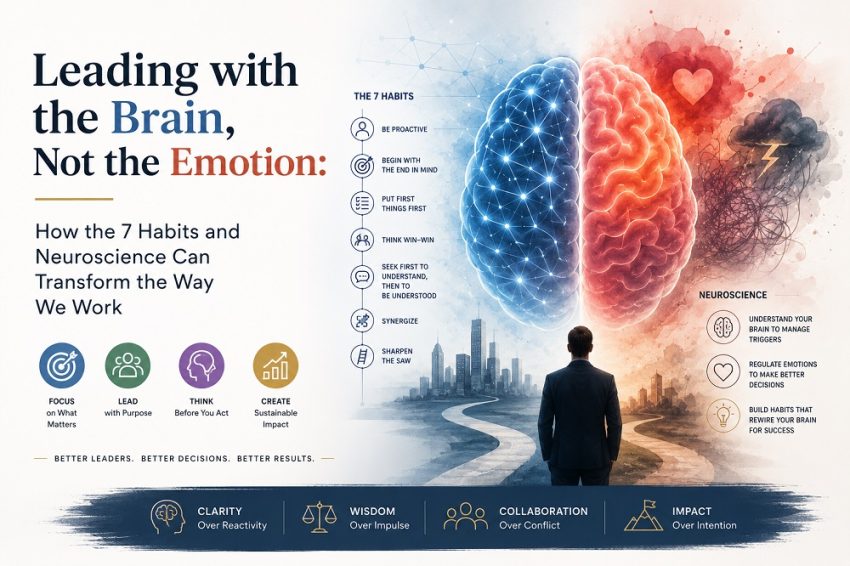
A reflection on Stephen R. Covey’s timeless principles, seen through the lens of how our brain actually works.
There is a quiet but profound tension that lives inside each of us every single day, the tension between reacting and responding. Between the part of us that snaps, panics, or shuts down, and the part that pauses, reflects, and chooses wisely. Understanding that tension, and learning to work with it rather than against it, may be one of the most important things any of us can do, not just as professionals, but as human beings.
This piece is an honest attempt to explore that territory. It draws from Stephen R. Covey’s iconic work The 7 Habits of Highly Effective People, along with insights from modern neuroscience – specifically, how two key regions of our brain shape the way we lead, collaborate, and grow. It is written not as a definitive guide, but as a shared reflection, the kind you might have with a thoughtful colleague over a quiet cup of coffee.
First, a Question Worth Sitting With
Is destiny the same as fate?
In many cultures and traditions, these two words are used interchangeably. But there is a meaningful distinction worth considering. Destiny, in a spiritual sense, may refer to the ultimate end point, the place we are all heading toward, the outcome written in something larger than ourselves. Fate, on the other hand, is the path we walk to get there. And the path? That is shaped by us, by the choices we make, the habits we build, and the way we respond when life puts pressure on us.
The 7 Habits are, in many ways, a framework for deliberately shaping that path. They do not promise to change where we end up. But they offer something arguably more valuable: the wisdom and the tools to show up well along the way.
Understanding the Architecture of Our Responses
Before we explore the habits themselves, it helps to understand something fundamental about the human brain, because our daily behavior is, quite literally, a product of what happens inside our skulls.
Two regions deserve our attention.
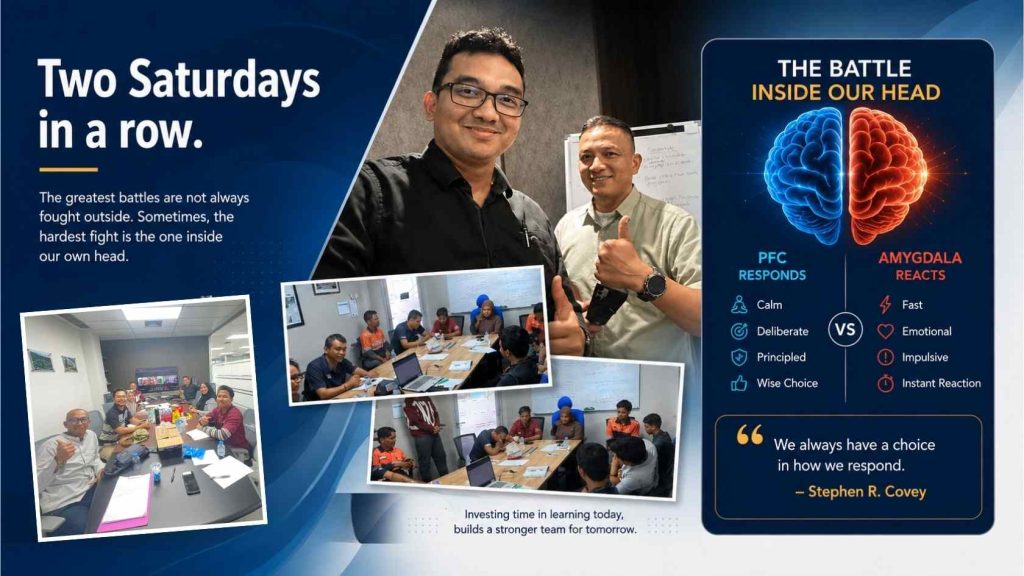
The Prefrontal Cortex (PFC) sits just behind the forehead, at the very front of the brain. It is the seat of what we might call our higher functions: logical thinking, long-term planning, impulse control, the ability to consider consequences before acting. When the PFC is active and in control, we are at our thoughtful best, calm, deliberate, forward-looking.
The Amygdala, by contrast, sits deep in the middle of the brain, within the limbic system. It is ancient, fast, and primarily concerned with one thing: survival. It scans constantly for threats, triggers the fight-or-flight response, stores emotional memories, and reacts in milliseconds, long before our conscious mind has a chance to weigh in.
Here is the key insight: both of these systems are always running. The question is which one is in the driver’s seat at any given moment.
When a vendor misses a deadline and we send an angry email we later regret, that is the Amygdala at the wheel. When a performance review catches us off guard and we become defensive and shut down, same driver. When we’re under pressure and we say something to a colleague we cannot take back, there it is again.
But when we pause before responding to a difficult message, when we listen to understand rather than to argue, when we choose a difficult conversation over comfortable silence, that is the PFC doing its finest work.
The 7 Habits, when understood through this lens, are essentially a training program for the PFC. Each habit, practiced consistently, builds the kind of mental and emotional architecture that allows us to respond from our best selves, even when circumstances push us toward our worst.
What Is a Habit, Really?
Before the habits themselves, it is worth pausing on what Covey means by the word “habit.” He defines it as the intersection of three elements:
- Knowledge : understanding what to do and why it matters
- Skill : knowing how to do it
- Desire : genuinely wanting to do it
All three must be present. Most of us have encountered situations where we knew what the right thing to do was, even knew how to do it, and simply did not want to. That gap between knowing and doing is where most personal development work actually lives. It is also, not coincidentally, where the Amygdala tends to win.
The neuroscience connection here is elegant: Knowledge and Skill are processed largely by the PFC, they are cognitive, learnable, improvable. But Desire often has a deeper, more emotional root. When desire is low, it frequently means the Amygdala is generating fear, avoidance, or resistance. The antidote is not willpower alone, it is building the habits gradually, in small steps, until the new behavior feels less threatening and more natural.
Also Read The Simple One : The 7 Habits of Highly Effective People
The Seven Habits: A Walk Through the Framework
Habit 1: Be Proactive – I Can. I Choose. I Will.
Proactivity is the cornerstone of everything that follows. Without it, the other habits are simply interesting ideas.
To be proactive, in Covey’s framework, is not merely to plan ahead or take initiative (though those are part of it). It is something more fundamental: it is the recognition that between any stimulus, any event, any frustration, any pressure and our response, there is a space. And in that space lies our freedom. Our choice.
Viktor Frankl, the Austrian psychiatrist who survived the Nazi concentration camps and wrote Man’s Search for Meaning, articulated this perhaps more powerfully than anyone. Even in conditions of unimaginable suffering and loss, he observed that the one thing that could not be taken from him was the freedom to choose his response. That is the essence of Habit 1.
In practical terms, proactivity means:
- Focusing on our Circle of Influence, not our Circle of Concern. There will always be things beyond our control, economic conditions, other people’s behavior, external pressures. Reactive people spend their energy worrying about these things. Proactive people ask: “What can I do? What is within my reach?” And they work there.
- Choosing proactive language. The words we use reveal and reinforce our mindset. “There’s nothing I can do” signals helplessness. “What are my options?” signals agency. “That’s just how I am” closes the door. “I can try a different approach” opens it. These small linguistic choices accumulate into an orientation toward life.
- Taking the pause. Before reacting, especially in emotionally charged situations – simply pausing for a few seconds can shift control from the Amygdala to the PFC. Breathe. Name what you are feeling. Give your rational brain time to come online.
An analogy from the presentation captures this beautifully: think of the Titanic. The captain who only reacts when the iceberg is already visible has run out of time. The proactive captain studies the charts before setting sail. Reactive behavior is always catching up to circumstances; proactive behavior shapes them.
Habit 2: Begin with the End in Mind – Clarity Before Action
Every meaningful endeavor is created twice: first in the mind, then in the world. A building begins as a blueprint. A journey begins with a destination. A life lived with purpose begins with a clear sense of what that purpose is.
Habit 2 invites us to define, with as much clarity as we can, what we are ultimately working toward, not just in our careers, but in all the roles we carry. As a parent, a partner, a colleague, a friend. What kind of person do we want to be? What do we want to be remembered for? What values do we want to live by, even when it is inconvenient?
These are not easy questions. But they are necessary ones. Without them, it is entirely possible to work very hard, be very busy, and still arrive, years later at a destination we never actually chose.
The PFC is the organ of vision. It is uniquely capable among the regions of the brain of imagining futures that do not yet exist, and working backward from those futures to inform present decisions. Habit 2 is, in a very real sense, a workout for this capacity.
Habit 3: Put First Things First – The Discipline of Priority
If Habit 2 gives us the compass, Habit 3 gives us the discipline to follow it.
Covey’s famous Time Matrix divides our activities into four quadrants based on two dimensions: urgency and importance.
- Quadrant 1 (Urgent + Important): Crises, deadlines, genuine emergencies. Work here is necessary — but if we live here permanently, we burn out.
- Quadrant 2 (Not Urgent + Important): Planning, relationship-building, professional development, preventive maintenance, reflection. This is where the most valuable long-term work happens — and it is the quadrant most consistently neglected.
- Quadrant 3 (Urgent + Not Important): Interruptions, certain meetings, others’ immediate demands. These feel important but are not aligned with our real priorities.
- Quadrant 4 (Not Urgent + Not Important): Time-wasters. We all know where these live.
The discipline Habit 3 asks of us is to schedule Quadrant 2 activities first — before the urgent and the trivial crowd them out. Covey calls these our “Big Rocks.” The principle, illustrated through a well-known teaching story, is this: if you fill a jar with small pebbles and sand first, the big rocks will not fit. But if you place the big rocks in first, the smaller stuff fills the gaps around them.
In practice, this means identifying, each week, the one or two things that truly matter most in each of the key roles we hold, and putting those in the calendar before everything else. Not as aspirations. As appointments.
Habit 4: Think Win-Win – Courage and Consideration
The first three habits – Habits 1, 2, and 3 – Covey calls “Private Victory.” They are about mastering ourselves. Habits 4, 5, and 6 are about “Public Victory” – about how we engage with others.
Habit 4 challenges one of the most deeply embedded assumptions in many professional cultures: that success is inherently competitive, that for me to win, someone else must lose. Covey argues that this assumption is not only limiting, it is usually false, and it consistently produces outcomes worse than what is possible.
Think Win-Win does not mean being soft, or always compromising. It means believing that in most situations, not all, but most – there is a solution that genuinely works for both parties. Finding it requires courage (the willingness to advocate for our own interests and needs clearly) and consideration (the genuine desire to understand and honor the other party’s interests and needs). Both matter. Without courage, we capitulate. Without consideration, we dominate. Neither is a win.
In team and supply chain contexts, this plays out in negotiations with vendors, in performance conversations, in cross-functional coordination. The Win-Win orientation asks: “What does a genuinely good outcome look like for both of us?” And then it works patiently toward that.
Habit 5: Seek First to Understand, Then to Be Understood – The Rarest Form of Respect
Of all the habits, this one may be the most immediately impactful and the most consistently violated.
Most of us, when someone is speaking, are not really listening. We are preparing our response, thinking about our counterargument, waiting for a pause so we can make our point. We listen autobiographically, filtering everything the other person says through our own experiences and assumptions.
Habit 5 asks us to do something genuinely rare: to listen with the intent to understand, not to reply. To be fully present. To set aside our own frame of reference long enough to enter someone else’s.
The neuroscience here is striking. When we are in Amygdala-dominant mode, defensive, anxious, threatened, we literally lose access to the higher-order cognitive functions that allow us to hear nuance, consider perspectives, and respond thoughtfully. The Amygdala is preparing arguments; the PFC is offline. But when we consciously slow down, breathe, and genuinely focus on understanding the other person, we activate the PFC. We can think more clearly, empathize more genuinely, and ultimately communicate more effectively.
Empathic listening, done well, is one of the most disarming and connecting things one human being can offer another. It builds trust. It de-escalates tension. And it almost always leads to better outcomes than conversations where both parties are simply waiting for their turn to talk.
Habit 6: Synergize – The Whole Is Greater
Synergy, in Covey’s framework, is more than cooperation or compromise. Compromise means each party gives something up. Synergy means both parties, through genuine collaboration, arrive at a third alternative, one that neither would have reached alone, and that is better than anything either of them originally proposed.
It requires trust. It requires the kind of deep listening developed in Habit 5. It requires the Win-Win orientation of Habit 4. And it requires a genuine belief that the perspectives and contributions of others are not merely tolerable but valuable — that diversity of thought, when engaged respectfully, produces better outcomes.
In team environments, especially in complex, interdependent functions like supply chain management synergy is not a luxury. It is a competitive necessity. Siloed teams, territorial behavior, and internal competition create friction that slows everything down and ultimately hurts the people the organization is trying to serve.
Habit 7: Sharpen the Saw – Renewal as a Responsibility
The final habit is deceptively simple: take care of yourself. Continuously renew and improve across the four dimensions of your being.
- Physical: Sleep, exercise, nutrition. (And it is worth noting that adequate sleep is one of the most powerful enhancers of PFC function, chronically sleep-deprived people show measurably impaired judgment and impulse control, essentially operating with a weakened prefrontal cortex.)
- Mental: Reading, learning, reflection, journaling. These activities literally strengthen neural pathways associated with PFC function.
- Social and Emotional: Meaningful relationships, empathy, contribution to others.
- Spiritual: Clarity of values, reflection on purpose, whatever form of contemplative practice gives you grounding.
The analogy Covey uses is of a woodcutter who is so busy sawing that he never stops to sharpen his blade. The result, paradoxically, is that he gets less done, not more. Renewal is not a retreat from effectiveness; it is the foundation of it.
The Journey of Growth: Dependence → Independence → Interdependence
Covey’s “Maturity Continuum” offers a useful map of where we might be at any given stage of development:
Dependence is where we all begin. We rely on others to take care of us, to make decisions for us, to solve our problems. “You have to take care of me.”
Independence is the Private Victory achieved through Habits 1, 2, and 3. We can manage ourselves, set our own direction, and take responsibility for our outcomes. “I can do this myself.”
Interdependence is the Public Victory, the recognition that even the most capable individual achieves more by collaborating well with others than by going it alone. “We can do more together.”
It is important to note that interdependence is not a return to dependence. Interdependent people are not weak or reliant, they are strong enough to choose collaboration, and wise enough to know when it serves everyone better than independence alone.
Habit 7 runs through all three stages, supporting continuous renewal regardless of where we are on the journey.
Fixed vs. Growth Mindset: The Brain’s Orientation Toward Challenge
Carol S. Dweck’s research on mindset maps neatly onto the neuroscience framework we have been exploring.
A Fixed Mindset – the belief that our abilities are essentially static, that we are who we are and cannot fundamentally change, is associated with Amygdala-dominant processing. Challenges feel like threats. Criticism feels like attacks. Failure feels final. The instinct is to protect, avoid, and disengage.
A Growth Mindset – the belief that abilities can be developed through effort, learning, and persistence, is associated with PFC-dominant processing. Challenges become opportunities. Criticism becomes feedback. Failure becomes data. The instinct is to engage, learn, and keep going.
The connection to the 7 Habits is direct: Habit 1 (Proactivity) requires a Growth Mindset, the belief that I have meaningful agency over my responses and my development. Habit 7 (Sharpen the Saw) is the Growth Mindset in action, the ongoing commitment to learning and renewal.
Five Steps from Reactive to Proactive
For anyone who finds this framework compelling and wants to know where to begin, here is a simple, practical sequence:
- Pause : Before reacting, take 3 to 5 seconds. Breathe. This small act gives the PFC time to come online before the Amygdala’s response is already out the door.
- Name the emotion : Ask yourself: “What am I feeling right now?” Research shows that simply labeling an emotion activates the PFC and reduces the intensity of the Amygdala’s response. This is not suppression, it is clarity.
- Check your paradigm : Is the way you are seeing this situation the only way it could be seen? What would someone with a different perspective notice? Is this a fixed or growth mindset moment?
- Remember your purpose : If you respond the way you are tempted to right now, does that move you closer to or further from what actually matters to you? What would the person you want to be do here?
- Choose a Win-Win response : Act with intention. Use language that is honest, clear, and oriented toward a good outcome for everyone involved.
A Final Reflection
None of this is easy. Anyone who tells you that developing these habits is simply a matter of reading a book and deciding to change is, with respect, not being fully honest with you. The Amygdala is fast, powerful, and has been shaped by millions of years of evolution. Our emotional patterns are deeply grooved by years of experience. Real change, the kind that sticks, the kind that transforms how we actually show up under pressure, takes time, practice, and a great deal of grace toward ourselves when we fall short.
But the direction matters. And the direction these seven habits point in, toward greater self-awareness, clearer purpose, deeper relationships, and a commitment to mutual benefit is, in this humble view, a genuinely good one.
We cannot always control what happens to us. We cannot always silence the alarm. But we can, with practice and intention, learn to pause before it runs us. And in that pause, small as it may seem lives something remarkable: the freedom to choose who we want to be.
This article is a personal reflection based on the leadership development material “7 Kebiasaan Manusia Efektif: Memimpin dengan Otak, Bukan Emosi,” developed for Supply Chain Management teams, drawing on Stephen R. Covey’s 7 Habits of Highly Effective People (FranklinCovey) and insights from neuroscience. All credit for the original framework belongs to Dr. Covey and the FranklinCovey organization
That’s all from me. I hope you find this valuable and insightful!
“Transforming Supply Chains, Empowering People, Delivering Results – Eddy Suryadi”
*Feel free to share this article with your network to help them gain valuable insights as well. For more tips and updates on supply chain management, don’t forget to connect with me on Linkedin